While boleia-ing home one afternoon, I had the great fortune of attracting the attention of a white SUV with a license plate from Gauteng Province – I had succeeded in what is typically thought impossible: the much-coveted South African boleia.
“Are you going to Chokwe?” I ask when they pulled over.
The middle-aged couple take a moment to consult their map before confirming that yes, they are headed to Chokwe.
“Great!” I say, and start to open the back door. I quickly realize it’s locked. And then I remember… oh right, South Africans. I lean back over to the passenger window and after running through a list of possible English translations for “boleia” settle for asking, “Um…could I get a ride?”
“Oh sure!” And the man unlocks the door and I climb in the backseat amid ice chests, bags of canned and processed food, fishing gear, suitcases and, miracle of miracle, air conditioning. I had found the four-leafed clover, the pot of gold at the end of a rainbow, the star power in the question box, and now my road would be easy.
Of course, the questions start.
So, you’re not afraid to hitchhike here? Not at all, it’s very common, and much safer than public transportation. Do you speak their language? Yes – I teach in Portuguese. What are you doing here? And the standard spiel about volunteering with Peace Corps, etc.
At this point, the wife turns around in her seat, and I can see the concern spilling out of her eyes as she ingenuously questions…
“Your students at the school, are some of them…black?”
(pause)
She’s speaking English, so I know there’s not a translation issue. But I suddenly feel like these people are so far from the world I know that I’d have more in common with a Portuguese-speaking Mozambican boleia.
Oh, South Africa.
This was one of my first real eye-opening experiences with the people who look like me living in the “developed” country next door, the one with the highest per capita on the continent and, startlingly, also one of the highest crime rates. I’ve only spent a brief time there myself – enough time to relish in efficient customer service and commercialism, but not enough time to have any idea about the culture. While answering questions and explaining a little about my life in Mozambique to the beach-bound tourists I often encounter, I also learn a lot about their country. Questions like these speak volumes.
At first, I thought most of the South Africans I encountered were simply the elite – they drive through Mozambique in their caravan of SUVs stuffed with food and water from their own country and their boats or trailers hitched on the back, not getting out of their cars from the border crossing to the resort run by their fellow South Africans except to fill up their 50-gallon tanks at the legit gas stations where the Indian owners accept credit cards and speak English better than they do. Naturally, these types are probably just as sheltered in their own country and completely unaware of how the other 95% of their fellow citizens live, and so I shouldn’t judge their country based on such a select group.
But then you run into the working class guys, usually here in Mozambique to make use of the country’s natural resources, so they can send the gas or water or sweet corn back to South Africa to be processed and packaged and sold back to Mozambique for triple the price, without Mozambique actually seeing a penny of profit.
One South African friend, who invited us to a barbeque (“braai” in South Africa) on the beach one day, comes from a family of farmers, far from the tourist hubs of Cape Town or skyscraper-lined Johannesburg. He told us about the atrocities black South Africans commit against his fellow farmers, burning the land and raping the white women, and how they had assassinated the president of the white-only Afrikaans farmers’ union. He told us about how these horror stories never made the newspapers because the media was corrupted by the government, run by a black president. He told us about how things were so much better during apartheid – less crime, less fear, more breaks for hard-working white folks. He told us about how he used to be friends with a volunteer up north, until they meet for a drink one day and she brought along her boyfriend – a black Mozambican – and he hadn’t spoken to her since then. He told us about how his niece goes to a preschool where a black kid also goes, and his brother forbids her to play with him and tells the teacher that he’ll take her out of the school if the black kid even touches his daughter. He told us how blacks are more like animals than whites, not even using a fork when they eat, but just using their hands. He told us how blacks just don’t deserve the rights they have in South Africa.
(At this point I think back to Mama Celeste, and remember the countless times she ate with her hands – there were three forks in the house, including a plastic one saved from a neighbor’s fancy wedding some years back, and when everyone was home those three weren’t enough to go around, so Mama C always made sure I had a fork and opted to wait until we were finished before cleaning one and using it herself or simply eating with her hands when possible.)
The one thought that kept running through my mind during this enlightening conversation was that South Africa today sounds exactly like what I would imagine from a pre-Civil Rights era United States. And it makes sense. Apartheid – the South African law of strict separation between whites and blacks – was eliminated less than twenty years ago. The majority of the blacks in South Africa have relatively new-found liberties after centuries of suppression, lack of decent education and generally being seen as less than human. And the whites are dealing with the fact that they are no longer entitled to all the perks of being superior and unquestionably in charge. Though the 13th, 14th and 15th Amendments to the U.S. Constitution made African Americans legally equal to whites in the late 1800s, it wasn’t until well after the Civil Rights movement that things really started to change there.
And the things he had to say about Nelson Mandela – did people once think the same thing about Martin Luther King Jr., who is today heralded as a hero of peaceful change in our culture? And do people honestly believe they have a God-given superiority over an entire race of people – to the point that they don’t even consider them to be the same race?
But being judgmental would just be hypocritical. I know without a doubt that had I been born in the US a century before, I would have the exact same view as these South Africans. These opinions are a reflection of society more than the individual. It's purely cultural.
Though I grew up in podunk Azle, with a larger number of trailer parks than African Americans, I also grew up watching The Bill Cosby Show with my grandparents, learning to count in Spanish on Sesame Street, celebrating Black History Month in schools, and singing “Red and yellow, black and white, they are precious in His sight…” at Sunday school. It has been ingrained in me since childhood that people of any race, belief, culture and country are created equal, and deserve respect accordingly. I’m not naïve enough to think that America is free of racism, discrimination and its fair share of race-based hate crimes, but I've never encountered someone my age who so adamantly held these beliefs, which I consider to be "old-fashioned."
Moreover, he was equally surprised that I, also being white, did not hold the same beliefs. We live in Mozambique as the average citizen does – we have the same cookie-cutter concrete houses as our colleagues, we speak (more or less) the same language they do, we also lament when water stops running or stretch out on our esteiras when it’s just too unbearably hot inside the house, and they are the people we turn to when we need help.
We told him these things. He seemed puzzled. Not really sure how to respond.
Of course, we also have South African friends living in Mozambique who are trying to learn the language, make friends and respect the cultural differences, frustrating as they might be at times. They make the effort, and they enjoy living in Moz because of it.
But when the South Africans from the aforementioned boleia stopped to drop me off at the market in Chokwe, they at first refused on the grounds that it wasn’t safe. I could understand their concern – the market is a mass of mud-and-stick stalls next to a chapa stop, where your car is swarmed by people wanting to sell you pirated phones, cheap plastic jewelry and homemade egg sandwiches out of a bucket when you stop. I have to assure them that it’s okay – I’m here every day, they know me, and I’m perfectly safe.
“You would never leave a white girl at a place like this in South Africa. There’s no telling what they’d do to you,” the man says as he reluctantly unlocks my door.
Unlike Mozambique, South Africa has an airport with more than one baggage claim, they have more than one TV channel, they have multiple-lane highways with brdiges and wastewater treatment plants, they have oatmeal, sanitary packaged meat, grapes and peaches, as well as big, clean cities where they hold world sporting events like the World Cup. But I feel perfectly safe in my town here in Mozambique. I’ll take that over McDonald’s any day.
My friend says he’s sure that all the racial tension and violence will lead to a full-on war between South African whites and blacks. I say I’m certain things will get better – it just might take a few generations.
Thursday, 10 November 2011

Friday, 26 August 2011
OBRIGADA!
Muita obrigada!
A huge thanks to everyone who supported and contributed to the Books for Kids Africa project for the Escolinha Estrela da Manha! On August 9, BKA delivered 200 children’s books in Portuguese and gave a full-day training on the care and use of the books.
A huge thanks to everyone who supported and contributed to the Books for Kids Africa project for the Escolinha Estrela da Manha! On August 9, BKA delivered 200 children’s books in Portuguese and gave a full-day training on the care and use of the books.

The collection includes everything from fairy tales and fables to Mini Laruousse dictionaries on dinosaurs and the human body. These books and accompanying activities will be incorporated into the curriculum in addition to individual reading (picture-looking) time.
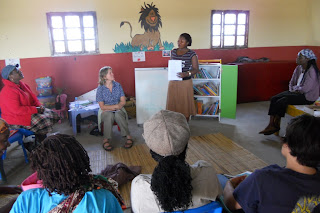 The goal is for the books to open up a whole new world through reading for the students. But the kids aren't the only ones who've been deprived of quality reading material.
 You’ve never seen 10 women more excited to discuss “O Arvore Generoso” – “The Giving Tree,” by Shel Silverstein.
 Actually, Khani found him. But he wasn't particularly sure what to do with him. The feeling was mutual.


Tuesday, 16 August 2011
The Adventure Continues!
Hello all!
Greetings from Moçambique! I just wanted to share some exciting news with you that I recently received. Peace Corps has offered me a position as a Peace Corps Volunteer Leader (PCVL) in Moçambique’s central office for next year. This means, starting in January, I will move to a new province a couple days’ north of my current site and work with Peace Corps to open new PCV sites, support current volunteers and coordinate trainings and other activities in the surrounding three provinces. I will also be spending some time working with a yet-to-be-determined NGO in the city to gain more international development experience.
This is not a decision I made lightly, but after plenty of prayer and talking with some former PCVLs, friends, PC staff members, I genuinely believe this is where I’m meant to be next year. I get another year to improve my Portuguese, get a better feel for development work and decide where I want to end up for grad school afterward. And, ok, I’ve kind of fallen in love with this country.
I’m thrilled at the opportunity, but I know this also means that I’ll be away from you – my family, friends and support network – for another year. Thankfully, PC is paying for me to go home for a month, from December 16 to January 16, and I’ll see everyone then. And then be home for good at that time in 2012. This also means that you have another year to come visit me in Africa. Cape Town, Victoria Falls or Mount. Kilimanjaro, anyone?
I’ll keep you posted as I hear more about my home for the next year on facebook and my blog (pcvalcooper.blogger.com). Or, I’m always up for Skype dates (valcooper87). Love you all and looking forward to seeing you in a few months! Fique bem!
Saturday, 13 August 2011
Dr. Jekyll, Mr. Hyde and Teacher Valeria
I’ve discovered I have a mild personality disorder when it comes to teaching.
In my Medio classes, I have about 25 students between the ages of 18 and 45. When the bell rings, I’ll start with a warm “Good morning!” to which they respond “Good morning, Teacher Valér!” and maybe a comment on some novidades – “news” – about the weather or something from the news or some changes in the school, which sometimes leads to a brief discussion. Then I’ll tell them to turn in their homework while doing the warm-up activity so I can call roll. When break time comes around, since many classes last two hours, they have five minutes to do whatever they need to, and when they return I’ll usually introduce them to English exercise vocabulary (i.e., we do “jumping jacks” or “jog in place” or simply “stretch – reach for the sky!”) to make sure they’re awake for the rest of class. If we finish early, particularly when they do activities in pairs, I’ll let them leave early, but most of the time it’s the opposite – someone will ask a question that turns into a debate that gets us all off topic for a little bit, but hey, it’s all in English, it’s a cultural exchange and they’re often more engaged than when we talk about present perfect or second conditional or whatnot. (Digression: One of my favorites was when we were learning religious vocabulary and got onto the topic of family – my students were appalled to hear that it’s not looked down on or uncommon to be unmarried or to be married and not have children in the United States, which led to a debate about cultural expectations and reasons for not getting married. When I challenged them with my personal take on the issue, one of my best students put her new vocabulary to use and asked me in all seriousness, “Teacher, do you want to be a nun?” I had to apologize afterward for laughing so hard.) In short, I leave my Medio classes with an elevated hope for Mozambique and humanity in general and feeling confident that I could be content to do this in some capacity for the rest of my life.
Then, I have Basico.
The youngest students are 13, but the older ones (18, 20, 24) are the ones to watch out for in these classes of 40 students. I walk into class with a bellowing and severe “Good morning!” which actually means “Sit down and be quiet – Teacher Valéria’s here.” I shut the door after I call roll, and if students try to enter after that I tell them I’ve already marked them absent but they can stay if they want to. While they do the warm-up, I walk from desk to desk to collect homework – if they don’t have it out and ready to hand in when I pass, I don’t accept it.
If you talk out of turn, you get one reminder before I tell you to leave the classroom. If I catch you sleeping, I tell you to leave the classroom. If you show that you clearly aren’t paying attention when I call on you, I tell you to leave.
I make a conscious effort not to smile in my Basico classes. The ones who’ve spoken to me outside of class know I’m really a softie, but they also know that ends when you walk through my door.
Unlike last school year, I have not had any discipline problems in my Basico classes. I have also noticed a definite increase in the number of homework assignments I receive and a sharp decrease in the number of tardy arrivals.
I’m pretty sure they’re terrified of me. But they can warm up to me in a few years when they’re in Medio. I got this system from my favorite teacher – my mom.
I also teach at the nearby Instituto Superior Politecnico da Gaza – the rough equivalent of a technical college – where I am “Doutora Valer,” since I have a degree. I teach first year English, which means I’m stuck in a tiny classroom with 100+ college freshmen (the majority boys) for a few hours every week. I have to keep these guys – most of them my age or older, though I will never tell them that – under control enough to teach some finer (more boring) points of the English language. At one point, I genuinely considered bringing my Peace Corps-issued air horn to class. However, I’m not about to baby-sit them and it’s not particularly my concern if they fail to show up or turn in their homework and I’m not going to hunt them down if they miss an exam. When students come up with sob stories about why they missed this or didn’t turn in that etc. etc., I’m pretty merciless, because, heck, they’re adults, they should be able to take care of themselves and their bosses won’t coddle them when they’re in the real world, either. But I also have no problem diving into an off-topic discussion or sharing personal anecdotes or jokes with them. If there were just about 80 less of them, we’d probably all be great friends (as long as they don’t know I’m single.).
And then, once a week, I go to the preschool. I’m welcomed with shouts of “Mana Valér! How are you?” And I hug and I kiss boo-boos and I wipe tears and I don’t mind when one goes an entire day without once letting go of my blue jeans. The teachers and I have a tacit agreement – they’ll handle discipline and yelling and keeping the kids on task, and I’ll handle the encouragement and praise and confidence-building you just don’t find in this country.

Thankfully, I also have weekends with friends, when I can talk about anything, make some good food, play games, and just be Valerie for a while.
In my Medio classes, I have about 25 students between the ages of 18 and 45. When the bell rings, I’ll start with a warm “Good morning!” to which they respond “Good morning, Teacher Valér!” and maybe a comment on some novidades – “news” – about the weather or something from the news or some changes in the school, which sometimes leads to a brief discussion. Then I’ll tell them to turn in their homework while doing the warm-up activity so I can call roll. When break time comes around, since many classes last two hours, they have five minutes to do whatever they need to, and when they return I’ll usually introduce them to English exercise vocabulary (i.e., we do “jumping jacks” or “jog in place” or simply “stretch – reach for the sky!”) to make sure they’re awake for the rest of class. If we finish early, particularly when they do activities in pairs, I’ll let them leave early, but most of the time it’s the opposite – someone will ask a question that turns into a debate that gets us all off topic for a little bit, but hey, it’s all in English, it’s a cultural exchange and they’re often more engaged than when we talk about present perfect or second conditional or whatnot. (Digression: One of my favorites was when we were learning religious vocabulary and got onto the topic of family – my students were appalled to hear that it’s not looked down on or uncommon to be unmarried or to be married and not have children in the United States, which led to a debate about cultural expectations and reasons for not getting married. When I challenged them with my personal take on the issue, one of my best students put her new vocabulary to use and asked me in all seriousness, “Teacher, do you want to be a nun?” I had to apologize afterward for laughing so hard.) In short, I leave my Medio classes with an elevated hope for Mozambique and humanity in general and feeling confident that I could be content to do this in some capacity for the rest of my life.
Then, I have Basico.
The youngest students are 13, but the older ones (18, 20, 24) are the ones to watch out for in these classes of 40 students. I walk into class with a bellowing and severe “Good morning!” which actually means “Sit down and be quiet – Teacher Valéria’s here.” I shut the door after I call roll, and if students try to enter after that I tell them I’ve already marked them absent but they can stay if they want to. While they do the warm-up, I walk from desk to desk to collect homework – if they don’t have it out and ready to hand in when I pass, I don’t accept it.
If you talk out of turn, you get one reminder before I tell you to leave the classroom. If I catch you sleeping, I tell you to leave the classroom. If you show that you clearly aren’t paying attention when I call on you, I tell you to leave.
I make a conscious effort not to smile in my Basico classes. The ones who’ve spoken to me outside of class know I’m really a softie, but they also know that ends when you walk through my door.
Unlike last school year, I have not had any discipline problems in my Basico classes. I have also noticed a definite increase in the number of homework assignments I receive and a sharp decrease in the number of tardy arrivals.
I’m pretty sure they’re terrified of me. But they can warm up to me in a few years when they’re in Medio. I got this system from my favorite teacher – my mom.
I also teach at the nearby Instituto Superior Politecnico da Gaza – the rough equivalent of a technical college – where I am “Doutora Valer,” since I have a degree. I teach first year English, which means I’m stuck in a tiny classroom with 100+ college freshmen (the majority boys) for a few hours every week. I have to keep these guys – most of them my age or older, though I will never tell them that – under control enough to teach some finer (more boring) points of the English language. At one point, I genuinely considered bringing my Peace Corps-issued air horn to class. However, I’m not about to baby-sit them and it’s not particularly my concern if they fail to show up or turn in their homework and I’m not going to hunt them down if they miss an exam. When students come up with sob stories about why they missed this or didn’t turn in that etc. etc., I’m pretty merciless, because, heck, they’re adults, they should be able to take care of themselves and their bosses won’t coddle them when they’re in the real world, either. But I also have no problem diving into an off-topic discussion or sharing personal anecdotes or jokes with them. If there were just about 80 less of them, we’d probably all be great friends (as long as they don’t know I’m single.).
And then, once a week, I go to the preschool. I’m welcomed with shouts of “Mana Valér! How are you?” And I hug and I kiss boo-boos and I wipe tears and I don’t mind when one goes an entire day without once letting go of my blue jeans. The teachers and I have a tacit agreement – they’ll handle discipline and yelling and keeping the kids on task, and I’ll handle the encouragement and praise and confidence-building you just don’t find in this country.
Thankfully, I also have weekends with friends, when I can talk about anything, make some good food, play games, and just be Valerie for a while.
Thursday, 14 July 2011
What Statistics Can't Tell You
Being a Peace Corps Volunteer in sub-Saharan Africa, you can only imagine how much we hear about malaria - it's about the most popular topic aside from HIV/AIDS. During our three month training, there was no end to the information - parasites from this mosquito, these blood cells explode, these pills prevent, those medicines treat, these programs fight it all over the country, etc etc and hey does Lisa have a new capulana dress, cause I need to talk to her tailor... Like most things, you don't really pay attention - and really, can't fully understand - until you experience it.
Whew.
But even this experience is not the REAL malaria experience.
I, as an American citizen and a Peace Corps Volunteer, am an exception. From the beginning, I'm given a prevention pill that is practically guaranteed to keep me malaria-free - so long as I remember to take it (and believe me, I will never forget again). I had, for all practical purposes, a personal doctor who covered me in cold compresses and literally held my hand throughout the whole ordeal. I went to a hospital where I was served food and had nurses and multiple physicians checking on me constantly. After that, I was put up in a hotel and given money for food and transport in order to recover, and received follow-up testing.
When most Mozambican citizens get malaria, they first have to find a way to get to a hospital or health center - which can involve countless hours or even days on public transportation. Once there, they sit on a hospital porch with sometimes up to 100 other people for hours to wait to have a hospital technician give them an instant but not always accurate malaria test. If they are positive, they are handed a prescription for pills. They get the pills at the pharmacy. And then they go home.

And that's the best case scenario. Unfortunately, it's not always the case, as we learned in our training sessions.

And Peace Corps is all about experiences, right?
But perhaps if I had listened a little more closely, I wouldn't have wound up in the hospital...
As detailed in a previous entry, I had an amazing time when Kris came to visit, going on a safari and snorkeling in the lagoon. Unfortunately, I apparently had such a good time that I forgot to take my weekly malaria prevention pills.
At the end of the trip, Kris and I headed back to Johannesburg, South Africa, and through a strange but convenient twist of fate, we arrived a day earlier than planned - on Friday, and Kris's flight and my bus were leaving on Sunday. That evening, we ordered dinner at the hotel. Though it was a delicious (and to my PCV pocketbook, expensive) meal, I didn't have much of an appetite, and I ended up taking most of it in a to-go box.
So when I tossed my cookies in the middle of the night, I figured it must’ve been the fast food we had picked up on the road.
When it happened again the next morning, I counted my blessings that we had nothing planned for that day and we hung out around the hotel watching B-rated movies on TV, reading, and, in my case, sleeping, all day. After a full day of rest and much crackers and Sprite (Mom's best sick food next to cream of mushroom soup), I was sure I'd be fine.
Sunday morning, after spending some more time sitting beside my friend the toilet bowl and assuring Kris that I would be fine and she couldn’t miss her flight, we headed to the airport. I left her there and took a taxi to catch my 8 am bus back to Mozambique.
At the station, after becoming acquainted with both a toilet and trashcan and ensuring that I had paper bags on hand for the ride, I found my way through the line and onto the bus. I was asleep within five minutes of sitting down - in a carefully selected seat without any obstructions between me and the bathroom.
I stayed that way for most of the next nine hours. The one unfortunate exception being when we had to cross the border. In the immigration lines, I leaned on the wall. Then I leaned on the railing that separated the lines. Then I leaned on a random stranger or two. Somehow, standing up was simply exhausting. I made it to the booth where the immigration officer gave me curious looks but stamped my passport anyway, then made a bee line back for the bus. I fell asleep.
My seat neighbor was kind enough to wake me up when we pulled up to the bus stop in Maputo at 4:30. And then wake me up again after everyone else had gotten off at 4:35. Praise be to advance planning, the hostel where I’d arranged to spend the night was only two blocks from the bus drop-off. I saw those two blocks as a necessary evil that must be conquered in order to reach the prize - a bed - and with that driving force, I managed to keep my feet moving straight through the front door and to a top bunk in a room full of Germans getting ready to head out for the evening. I ate half a cracker, had another sip of Sprite, and fell asleep just before 6 o'clock.
At this point in time, any normal person probably would’ve suspected that something, possibly more serious than bad beef, was wrong. But I was sure that if I just slept through that night, I'd be fine to catch the chapa for the four-hour ride back to Chokwe in the morning.
The following morning, when my crackers and Sprite from the day before made a frustrating reappearance, I decided it would be best to take advantage of the fact that it was Monday and I was in the same city as the Peace Corps office and our Peace Corps Medical Officer. If nothing else, she'd be able to hook me up with some Pepto or whatnot.
I didn’t even attempt public transportation, but instead called a taxi to take me to the PC office (which cost more than my four-hour ride home) to minimize the amount of time I had to spend in an upright position. At the office, our beloved PCMO, Dr. Isadora, listened to my symptoms, found I didn't have a fever, and hooked me up with some pills, Gatorade, a hotel room for the night and a firm order to eat something.
The next morning, I was asleep on Dr. Izzy's office couch when she came out of a meeting. I explained that I'd followed her instructions, but all the pills and fruit-punch flavored Gatorade had done was brighten up the toilet bowl a bit in what was now part of my morning routine.
When the thermometer said I had a fever of 103, out came needles and a line of various tests for illnesses I only vaugely remembered from training. It wasn't long before one came back positive.
Malaria.
I was more than a little surprised and annoyed at this prognosis, which came with a whole new set of meds, cold compresses on my forehead and stomach, and a very concerned PCMO.
I slept. When Dr. Izzy woke me up later, it was to say that the fever wasn't getting better. Could I make it to her car to go to the hospital?
But not a real Mozambican hospital. No, near the waterfront of Maputo, deep in the territory of embassies and houses with tall gates and multiple guards and garages that have two cars, where expatriates go to enjoy the cheap living of a developing country, is a private clinic. Thank God.
At the clinic, Dr. Izzy and the part-time PCMO, Dr. Nurja, introduced me to two other physicians, a couple more shots and an IV that caused a permanent ringing in my ears (quinine?) and a room on the second floor that would be my home away from home.
My notebook during the next 48 hours makes for an interesting read that I am unquestionably going to burn when I die. But from the dream-like tidbits I can remember and the pages I wrote, I apparently spent my time in the clinic counting the number of holes from needles (two in my left wrist for the IV, three in my left elbow and two in my right for unknown reasons, and two in places we won’t speak of), counting the TV channels (four), counting the ceiling tile, avoiding the deplorable food despite the fact that I hadn’t really eaten in five days, talking on the phone with the Aggie (I wasn't aware of this until he called again a few days later and asked if I was better, at which point I asked, "How'd you know I was sick?" and got a rather disconcerting answer...), and assuring the doctors that I was going to die of boredom sooner than malaria and to please let me go recover somewhere with more TV channels.
And in between all that, I slept.
Thursday, when I was a little more lucid and conscious, one of the doctors finally said that I was fine to leave the hospital so long as I didn’t overexert myself. The IV was removed (I could hear again!), I was helped out the door and to a waiting taxi and found myself back at the hotel.
Friday morning, I ate a bowl of cereal at the hotel. I officially broke it off with the toilet bowl.
My meals the next few days were small and simple and always accompanied by Gatorade and a cocktail of three different drugs (six pills at breakfast, three pills at lunch, six pills at dinner). On Saturday, by far the most helpful aid in my recovery arrived in the form of Clancy, Louise and Jenn, all the way from Chokwe, who reintroduced me to the joys of food in Maputo. On Tuesday, a week after I was first admitted to the hospital, I went back to the clinic for a final blood test. It tested negative for malaria.
Whew.
But even this experience is not the REAL malaria experience.
I, as an American citizen and a Peace Corps Volunteer, am an exception. From the beginning, I'm given a prevention pill that is practically guaranteed to keep me malaria-free - so long as I remember to take it (and believe me, I will never forget again). I had, for all practical purposes, a personal doctor who covered me in cold compresses and literally held my hand throughout the whole ordeal. I went to a hospital where I was served food and had nurses and multiple physicians checking on me constantly. After that, I was put up in a hotel and given money for food and transport in order to recover, and received follow-up testing.
When most Mozambican citizens get malaria, they first have to find a way to get to a hospital or health center - which can involve countless hours or even days on public transportation. Once there, they sit on a hospital porch with sometimes up to 100 other people for hours to wait to have a hospital technician give them an instant but not always accurate malaria test. If they are positive, they are handed a prescription for pills. They get the pills at the pharmacy. And then they go home.
And that's the best case scenario. Unfortunately, it's not always the case, as we learned in our training sessions.
- Malaria is responsible for 20 percent of all childhood deaths in Africa.
- 10,000 pregnant women in Africa die each year because of malaria-related causes.
- Malaria is responsible for 30 percent of all hospital deaths in Mozambique.
- There are between 300 and 500 million clinical cases of malaria each year, resulting in 1.5 to 2.7 million deaths.
- More than one million children die of malaria in Africa annually - that's an average of 2,800 a day.
- About 80 to 90 percent of the world's malaria deaths occur in sub-Saharan Africa.
*statistics courtesy of the World Health Organization
My First Visitor!
After a year of nagging her, I finally convinced Kris to come visit. And despite what she might tell you, it wasn’t even under false pretenses.
Our adventures started when I picked Kris up at the airport in Johannesburg, after a 12-hour trip from my home in Mozambique. From there, we drove to Kruger National Park, and within thirty minutes of entering the park, we’d seen these… ... and these…
  …and these…
…and we were pretty excited.
We stayed in huts like these – don’t be fooled, they have hot running water, electricity and generally put my Moz home to shame. On the second day, we took a sunset safari and even saw some of these. In fact, they surrounded our car, then hung out all over the road to soak up the heat of the concrete.
  On the third day, Kris and I turned off the nice paved roads with the nice white English-speaking South Africans on holiday in their SUVs and campers…and we went to Africa.
Using a recently-opened and apparently not-often used border with Kruger’s Mozambican cousin, Parque Nacional de Limpopo, we took the one road all the way through the park and headed to Chokwe.
After roughly six hours on trails that might have once upon a time been considered roads, we arrived safe and sound at home. Khani was glad to see us.
After convincing Kris that the terrifying natives would not eat her, we spent a day wandering around Chokwe, seeing the school and market and meeting friends.
And after that, we grabbed my roomie Clancy and headed on to the Bilene lagoon. Here, we encountered by far the strangest creature of our journey – the Aggie. Complete with a boat called “The Spirit of San Jacinto,” a brand of Texas on his chest and a tattoo that says “Howdy” on a place other than his chest, the Aggie greeted us with a warm handshake and a glass of an ice cold local beverage that can only be described as Texas-sized. He and his Zimbabwean counterpart, Joe, hooked us with kayaking, snorkeling with sea horses and endless dirty pirate songs and jokes on the lagoon.
And there was plenty of time for this, as well.

 At the end of the day, we walked down to the market for fresh shrimp, cooked with lemon and garlic over charcoal right on the porch. Beats any hibachi.

Alas, our adventures came to an end, and we returned to the Johannesburg so Kris could catch her plane back to civilization.
You, too, could be the proud owner of photos such as these! Contact your local travel agent and book your next flight to the magical land of sub-Saharan Africa.
Our adventures started when I picked Kris up at the airport in Johannesburg, after a 12-hour trip from my home in Mozambique. From there, we drove to Kruger National Park, and within thirty minutes of entering the park, we’d seen these…
... and these… …and these… …and we were pretty excited.
We stayed in huts like these – don’t be fooled, they have hot running water, electricity and generally put my Moz home to shame.
On the second day, we took a sunset safari and even saw some of these. In fact, they surrounded our car, then hung out all over the road to soak up the heat of the concrete. On the third day, Kris and I turned off the nice paved roads with the nice white English-speaking South Africans on holiday in their SUVs and campers…and we went to Africa.Using a recently-opened and apparently not-often used border with Kruger’s Mozambican cousin, Parque Nacional de Limpopo, we took the one road all the way through the park and headed to Chokwe.
After roughly six hours on trails that might have once upon a time been considered roads, we arrived safe and sound at home. Khani was glad to see us.
After convincing Kris that the terrifying natives would not eat her, we spent a day wandering around Chokwe, seeing the school and market and meeting friends.
And after that, we grabbed my roomie Clancy and headed on to the Bilene lagoon. Here, we encountered by far the strangest creature of our journey – the Aggie.
 Complete with a boat called “The Spirit of San Jacinto,” a brand of Texas on his chest and a tattoo that says “Howdy” on a place other than his chest, the Aggie greeted us with a warm handshake and a glass of an ice cold local beverage that can only be described as Texas-sized. He and his Zimbabwean counterpart, Joe, hooked us with kayaking, snorkeling with sea horses and endless dirty pirate songs and jokes on the lagoon.
And there was plenty of time for this, as well.
At the end of the day, we walked down to the market for fresh shrimp, cooked with lemon and garlic over charcoal right on the porch. Beats any hibachi.Alas, our adventures came to an end, and we returned to the Johannesburg so Kris could catch her plane back to civilization.
You, too, could be the proud owner of photos such as these! Contact your local travel agent and book your next flight to the magical land of sub-Saharan Africa.
Subscribe to:
Posts (Atom)