Monday, 20 August 2012

Great Northern Adventure! Part III

July 27

Cape Maclear - Cuamba = 279 km
Sometimes I lie awake at night and dream about driving a private car.

And on this particular Friday morning, I awoke from such a dream to climb into the back of a pick-up with 12 other people a a massive box of dried fish on the way back to Monkey Bay. At one point, a lady even tossed her bundled baby into  my lap so that she could climb over people to get in (thankfully, she took him back after only a couple not-so-subtle reminders). From Monkey Bay we caught a chapa to Mangochi, and in Mangochi (after realizing the open-back chapa was practically empty and therefore not leaving for quite some time, we had a godsend – literally, we got a boleia with two Italian nuns. Religious boleais are almost as good as South African boleias: they don’t lack for funding and so have top-notch vehicles with seatbelts and A/C, and while they might not buy you things as South African are prone to do, they usually drive very safely.  On the way, we had even better fortune to spot a congress of these along the side of the road...

(Stole this from Google image. But this vaguely resembles the mental image I took. Close enough.)


A boleia in the back of a bread truck, another bike taxi across the border and we were back in good-ole Portuguese-speaking Moz.

At which point we boarded the Open-Back from Hell. Hell, because I imagine Heaven as being a very clean place, and this was the exact opposite.

I have never in my life been dirty to the extent that I have in Mozambique. At the end of this particular day, I would take a bucket bath where the bath pooling around my feet was so brown I couldn’t see my toes. But that’s later; at this point in the story, it was simply me, Emily, Annie, a looooooong stretch of dirt road and the open sky.

The trees and bushes along the side of the road looked like they were carved from copper because the layer of red dirt was so thick on them. You could feel the dirt hitting you and sticking to the mixture of sunscreen and sweat on your skin. You could write words on your forehead simply by rubbing with your finger (lasts about thirty seconds, then turns brown again). And God forbid you have an itch because your fingernails fill with all kids of indescribable gross when you scratch. When Emily took off her sunglasses at the end of it all, it looked like she’d had a particuarly intense session in the tanning bed. This is what dirty means. And this is how we sat for four hours (minus the ten minutes where we stopped because our driver hit and killed a goat crossing the road and he had to run back and pay the goatherder).

When we finally arrived in Cuamba, Emily and I said tchau to Annie, who was catching another chapa back to Gurue. The two of us then sought out lunch and the train station, our plan being to spend the night with PCV Jama and hop the 5 am train to Nampula the following morning.

The train arrives anywhere between 15h and 19h, and it is only then that you can buy your tickets. Emily and I planted ourselves in front of the ticket window around 16h and passed the time reading, resting, dreaming of showers, and chatting with fellow travelers we met – a young couple doing a sub-Saharan Africa tour from France, and a middle-aged couple traveling Mozambique from Spain. And we waited, as the plaza slowly filled up with people.

I’m still not certain how people knew the train was coming. But all at once, there was a mad rush for the ticket window. People don’t really believe in lines, so it’s just kind of however many people can mass into a marked area and then force their way through whatever means to the destination, be it ticket window, chapa door or ATM. We had worked out a plan, and while Emily raced for the throng.

Thankfully, before the even started selling the tickets, I receive a message from Jama saying that she was friends with the station master, had reserved our tickets, and needed only to find and pay him to get them. So I moved in the opposite direction of the throng, found the man who was quite amiable, and had the tickets in my hand before the ticket window opened. This is why PCVs are awesome.

Once we got our tickets, we found our way to Jama’s house, where she and PCV Zacarias had already prepared dinner. I finally rinsed that layer of dirt of my skin. And we crashed in bed.


July 28

Cuamba - Ilha de Moçambique =531 km


Think Hogwarts Express. Think the Orient Express. Think AmTrack. And then think that it hasn’t had a change of upholstery or anything else for about thirty years. That is the train that runs from Cuamba to Nampula.

We arrived at the train just before 5 (and remember, this is the middle of winter). Passing by the cargo cars, you could see people moving things around in the dark using the light their cell phones. Emily and I splurged for second-class tickets, which meant we were in a compartment. I could just make out four other gray-ish shapes in the light from the train station coming through the window in compartment G – our cabin mates.


We snuggled into our cozy compartment for the 11-hour ride, most of which was spent chatting, reading, sleeping, snacking and watching the mountains fly by the window. By far the best way to travel in Moz.

The villages along the train track seemed only to exist because of the train. Each place we stopped would already have a crowd of people, and not just to board. Instead, people flocked to the windows with baskets and buckets on their heads piled high with fruits, veggies, cokes, water, whatever, to sell.

Unfortunately, a large number of the vendors were kids, which made the whole money/goods exchange out the side of the window a bit tricky.


The other tricky part made me wish that I hadn’t bought the bottled water from that kid… I didn’t take a picture of the bathroom, but allow me to describe: closet with hole in the bottom. A decent-sized hole at that, big enough to lose your leg in if you’re not careful. When you first enter, it’s actually a bit mesmerizing to watch the tracks fly by through the hole. But then you get over the fascination when you realize this is absolutely all you have to work with. And then begins the fun task of bracing yourself against the walls over said hole, trying to maintain both your balance and your aim as the train bumps along the tracks while trying not to think about all the others who have attempted (some without success, as is plainly marked) the same before you.

We arrived in Nampula around 17 and walked to the chapa station with the Spanish couple to catch a chapa to Ilha de Mozambique. The magical transport with plenty of space, cushy seats, and food walking up to the window was gone. But not before an obligatory train photo was taken.

And we were off to Ilha.


July 29

First, a bit of history about Ilha de Moçambique…

Ilha is known for being the first place in Moz colonized by Europeans, but it was actually an Arab port before that. In fact, the island and subsequently the country got its name from an Arab trader, Musa Al Big. In 1498, the Vasco de Gama of fifth-grade history class legend arrived and Ilha became the capital of the Portuguese East Africa company, which traded in slaves, spices and gold.

The Portuguese have long since been chased out and the tiny island’s 14,000 current inhabitants are 95% Muslim, but the fort, hospital, churches and narrow streets that look like they fell straight out of Europe still stand. The island is reached via a 3km bridge from the mainland, and can be traversed end-to-end in a little over an hour. It’s so narrow that in places without buildings, you can do a 180 and see both shores.

I’m pretty sure even de Gama himself wasn’t as excited as I was about finally arriving in Ilha.

The end of the island closest to the bridge, Makuti, is full of traditional Moz-style houses (cinder blocks and tin roofs). The entire neighborhood sits a few meters below the road, as this area was stripped of stones to build the fort and town on the ritzier end. Emily and I crashed with PCV Patrick on this side of town, and set out the first morning for the side known as “Stone Town.”

Most of the streets that cut through the multi-story, multi-colored stone buildings are barely wide enough for cars. Some of the buildings are well maintained, with bright shutters on the windows and flower pots on the tiny balconies. Others, however, have been home to only squatters for so long they’re literally caving in on themselves.


The old governor’s place – complete with statue of de Gama out front – is a museum, now in the process of being rehabilitated. Emily and I stopped by the palace to purchase our tickets to visit the Fortaleza São Sebastião. The fort was built between 1558 and 1620 and is the largest European fort in Sub-Saharan Africa.


A guard just outside the entrance took our tickets, then Emily and I had free reign to poke around in the old soldiers’ barracks, chapel, officers’ houses, kitchen, firing wall, etc. And perhaps a sunken ship at the edge of the slave auction site?


We also found that, after the fort ceased to be used and prior to being named an UNESCO protected site, other people had seen fit to utilize the area for different purposes.


"trancas," i.e. where people go to get their hair did


Beyond that, the fort was in surprisingly good repair. At least, enough that you could let yourself imagine what it must've been like to arrive at the fort a few hundred years ago.

Hidden in a corner of the fort is another gem: the Chapel of Nossa Senhora de Baluarte. Constructed in 1522, it’s considered the oldest European building in the southern hemisphere. The previous inhabitants were even still hanging on in the walls. It seriously felt like we’d somehow fallen through a rabbit hole and out of Africa altogether.


"Brother Fern...???"

But then we went and ate matpa de siri-siri – matapa (see previous entry) made with seaweed – and all was right with the world.


Afterward we wandered around (literally, we pretty much walked the circumference of the island) til we found a nice spot on the water to park it, read our books, and watch the sun set.


July 30

Have I mentioned that a perk of crashing with PCVs is that they always know people? The next morning, PCV Patrick (who apparently has a lot of guests…) called up a friend and Emily and I set off for a cruise on a dhow boat.

What distinguishes a dhow boat, you ask? Imagine if Gilligan and his crew had built a sail boat – without the help of the professor.

It’s essentially a wooden hull with slats across the middle to sit on. The “mast” is made of a series of long, thin poles lashes together with once-colorful rope, and they hoist it up using only a primitive pulley system that involves only more ropes. The mast itself is a patchwork of off-white canvas. One guy sits in the back guiding the hand-carved rudder, and the other one hops around directing and tying the sail. During launch and landing, you as a passenger might be asked to sit on different sides of the boat several times to help out the whole balancing process. In fact, for most of the ride back, one of our guides had to perch himself on the end of a stick wedged into the hull and hanging a good three feet over the water in order to balance us out.


Once the sail was tied down and we started cruising toward the mainland, Emily and I were free to kick back and dip our hands into the water as we sailed back to the mainland.

The place we landed, though back on the mainland, can only be reached by boat. Our guide took us across the thin peninsula to the open ocean on the other side. There was a tide pool just over a small hill, and this is where we broke out the snorkel gear PCV Patrick had lent us and dived in.

The pool was only about 30 meters across and of varying depths and mostly covered with vegetation at the bottom. And it was FULL of fish.

My favorite sighting? This guy:


Again, stolen from Google because my camera doesn't take kindly to water.

After exploring every inch of the tide pool, we wandered to the open water and spent the afternoon swimming, snorkeling, reading and sun bathing before our guy found us and took us back to the island.

We wrapped up the day meeting with two newly arrived PCVs, Megan and Caitlin, and Patrick at a rooftop restaurant. Emily and I split a giant lobster which they prepared over a charcoal fire a few feet away. Then we crashed in bed to get ready for the final leg of our trip: Pemba.

Wednesday, 15 August 2012

Great Northern Adventure! Part II

July 23
Gurue, ZambeziaàMandimba, Niassa = 317 km
The next day was not quite so pleasant. At 4:30 in the morning, Annie, Anna, Emily and I snuggled together in the back of a friend’s pick-up for the brief, frigid ride to the chapa stop in town. Bags in tow, we piled into the chapa and waited for it to fill complete up (chapas don’t leave until all 15 seats are filled with 25 people). After a few hours we were able to stretch our (now numb) legs in Cuamba before we got on another chapa to Mandimba, on the border of Malawi.  We arrived shortly after noon and went to the currency changing station (the place where the guys with huge wads of cash stand around and shout “American dollar! American dollar!” as you pass). The rate from the Malawian kwacha to the Mozambican meticais is about 10 to 1. The meticais to the American dollar is about 27 to 1. But if you didn’t know that, this would look incredibly impressive:
In Mandimba, we planned to stay with PCV Kyla. When we arrived, she said she was one town over waiting for a chapa to leave. So we sat down to have lunch and wait.
Lunch turned into afternoon snack.

Afternoon snack turned into dinner.

Dinner turned into late-night drinks.

And after countless games of King’s Corner, Solitaire, Snake on the phone, and anything else we could think of…we continued to wait.

It’s Mozambique. After three years, you just kind of roll with it.
Kyla finally arrived after 22 and we headed back to her place to crash on a mattress on her floor. Which was great because the next morning…


July 24
Mandimba - Cape McClear, Malawi = 129 km

When you don’t have a car at your disposal, you get really creative about modes of transportation. But by far the coolest mode of transportation in Moz: the bike taxi.

Which is exactly what it sounds like: you pay a guy (who hangs out in packs on the main street, much like the reputable money-changers) to take you somewhere on his bike. The bikes are perfectly outfitted for such endeavors – the metal square behind the seat normally reserved for transporting boxes of gin and goat is covered with a pad suitable (though not recommended) for sitting, and the pegs on the back wheel are reinforced to allow you to put your feet on them. While in transit, you are encouraged to hang onto your seat, or pretty much anything other than your driver. Biker. Whatever. And you comfortably sit and take in the view and try not to be offended when the biker starts huffing and puffing and having to stand up when you go up a slight incline. It’s really quite pleasant.
We said our farewells to Kyla and Anna and hopped on our respective "taxis." The ride to the Moz border took about 20 minutes. After having our passports stamped, we boarded our bikes again and crossed the gate into No Man’s Land, similar to the Demilitarized Zone between Romulan and Federation space. The ride between the two country’s gates took another 20 minutes, before we found ourselves getting our passports stamped again and surrounded by more (aggressive) bike taxis, money changers and people speaking what they claim is English.

After paying our taxis, we moved on to the next mode of transportation. Please note: we had very credible sources (other PCVs) advise us on traveling to Cape Maclear. One of the most important things they stressed was transport price “negotiation.” So when we went to the chapa (an open-back truck with a few people already on), the conversation went like this...

Annie: How much to Mangochi?
Driver: 1000 kwacha.
Annie: No, it's 500.
Driver: Ok, 750.
Annie: No, it's 500.
Driver: No, best price, 650.
Annie: It’s 500.
Driver: No, it’s 650!
Annie: It’s 500.
Driver: Okay, it’s 500.

And we get in and wait for them to drive the exact same 500 meter loop five times to pick up more people before we actually start in the direction of Mangochi.
The official languages of Malawi are Chichewa and English. Which means the government is run in English and everyone really speaks Chichewa except for when they see white people who they assume speak English and want something from them. However, in the back of the truck, we were pleased to find a Malawian that also knew Portuguese and amused ourselves by learning Malawian English.
Us: How do you say “capulana” in English?
Him: “Fabric.”
Us: Oh, wow! Fabric! What about “cobrador?”
Him: “Money collector.”
Us: Brilliant! And how do you say “boleia” in English?
Him: “Lift.”
Us: Whoa!

Unfortunately, we were also distressed to discover that they could also partly understand our English. I’m kind of ashamed to admit that Moz PCVs take it for granted that no one around them speaks English, so when we’re together we typically don’t filter our conversations as we should. (i.e., “Whoa, the man sitting next to me seriously smells like my latrine!” etc.) So, in this case, we simply reverted back to Portuguese. (i.e., “Epa, este homen ao meu lado cheira como minha latrina!”). It also made interesting reads along the way, as we passed the “God First Warehouse” and the “Fear Allah Market” and other such fun stores.
From Mangochi, we caught another chapa to Monkey Bay, and from Monkey Bay found a pick-up going to Cape Maclear. We arrived at the backpacker’s in the late afternoon. We put down our bags and stretched out for the view at our lodge on the shore of Lake Malawi.


July 25
Lake Malawi (Lago Niassa on the Moz side) is Africa's third largest lake and the eighth largest lake in the world. More interestingly, it's said to be home to more species of fish than any other freshwater body in the world. And on top of all that, it's absolutely gorgeous.
Cape Maclear is situated in a small peninsula on the southern end. The village is filled with backpackers and lodges along one main road, yet it’s still a relatively undiscovered and so doesn’t feel like a tourist destination. Walking along the beach, you’d pass the typical lodges with bars and wicker furniture and hammocks and landscaping – and then pass a fence and suddenly be in someone’s back yard, where women were busy washing clothes, dishes and children in the lake water. Alongside the kayakers, you’d see canoes made of hollowed-out logs and filled with fishermen and nets.
On one side of the road were the lodges with high fences and gates and signs that read “Guests only,” and on the other side it looked like the bush, with the addition of giant Baobob trees.

Another PCV characteristic is that we pride ourselves on not being tourists or just passing visitors – we live here, doggonit, and in Moz we expect you to treat us like any other Mozambican and address us in Portuguese (it’s a nice dream, anyway). So it was a little bit of a shock when we realized that people could speak pseudo-English to us, then turn to each other and speak Chichewa and we’d have no idea what they were saying. Oh yeah – suddenly, we were just more white tourists.
But we embraced it while walking around the small town and settled for learning “thank you” in Chichewa (“zikomo”). In the afternoon, we rented kayaks and snorkel gear from a nearby lodge and set out for an island less than a kilometer from shore.
After a lap around the island, we pulled our kayaks on shore and dove into the shallows. If you have never been snorkeling or scuba diving, I encourage you to do so. There’s simply nothing quite like hanging out in the water, alongside tons of gorgeous and brilliant fish, and just being a part of the underwater world for a while. Sadly, there are no pictures of this part.
After watching the sunset on the water, we returned to the lodge for potato skins and a chicken dinner before crashing in bed – around 9 o’clock.

July 26
Our final day in Cape Maclear was passed mainly eating delicious bean burrito-type dishes you can’t find in Moz and in perusing the jewelry and crafts in the countless stalls along the main road. One gentleman with a Bob Marley-type hat over his dreads tried to sell us his very own line of “Happy Pants,” and proceeded to sing us his Happy Pants Man jingle. I admire his marketing strategies, but got the impression his happiness had very little to do with pants.

In addition Malawi’s fine tourist-geared cuisine, we also sampled the country’s brew. One, Carlsberg, is a Danish beer bottled in Malawi. It’s light, refreshing, and sold for 250 kwacha.
The other, the true Malawian brew, is sold in 1-liter milk cartons for 150 kwacha and tastes like liquefied fermented dirty socks. And also vaguely resembles it. Called Chibuku, you are encouraged to shake it before drinking, and if you wait too long the milk carton-esque container starts to swell with the excess gas. We all took an obligatory sip and promptly chased it down with something else more fit for human consumption. Like, pretty much anything.
Overall, not a bad life on the shores of Lake Malawi.


Saturday, 11 August 2012

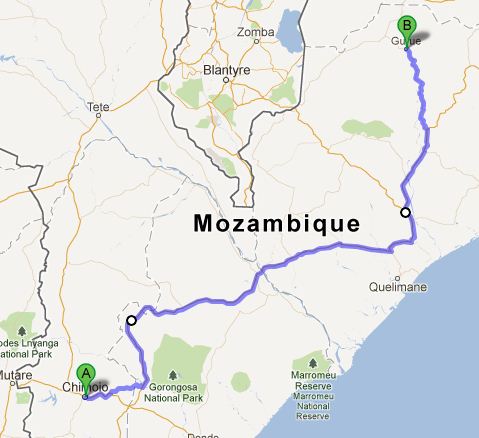
The Great Northern Adventure! Part I

During the school’s winter break, my sitemate/now roommate Emily and I decided to take a little trip up to Malawi and the Mozambican provinces we had yet to visit. Armed with a backpack each, a jar of peanut butter and no solid plans, we took off on the morning of July 21 on an excursion of more than 3,900 km - our Great Northern Adventure!

Part I

Chimoio, Manica - Gurúe, Zambezia = 814 km


July 21

We got up at 2:40 in the morning (careful not to wake the three sleeping people and one sleeping dog also crashing at my house that night) and headed to the chapa stop to see about buses north. They only had standing room on the big buses leaving at 3:30, so we opted instead for a small chapa to take us to the main road where we could boleia. Go figure, there’s not a whole lot going on at a chapa stop at 3:30h – at least nothing we wanted to be a part of – so we settled for finding our chapa and snuggled into the backseats to asleep until more people showed up and we left at 5h. Around 6:30, we arrived in the town of Inchope on the National Highway 1 (EN-1), which starts in the southernmost province and capital and stretches to the northernmost. After doing our boleia dance (flapping our hands at oncoming cars and looking desperate) on the side of the road for an hour, we had the great fortune to land a Chinese business bad English and worse Portuguese. Which didn’t deter his conversation and frequent chuckles at all. With limited vocabulary, a lot of gestures and five hours on the road, he told me about his work with cotton in Moz, how he misses his family and hopes to go back home (the Xindan province…?), and then explained that one of the songs we listened to (in between the Chinese boybands) was a song of praise (he broke out the English/Chinese dictionary on his BlackBerry and showed me the word – “Buddhism”). He turned off the road in the village of Zero (no joke) and Emily and I resumed our dance until a bus with two open seats pulled over around 13h. We settled in with books and iPods for the next few hours, until we got down at our turn-off at the electricity-less truck stop village of Nampevo around 18:30h. We walked to our next boleia spot using the light of our cell phones and the moon, where we had the incredible fortune to catch a small truck headed our way. An hour and a half later he told us that we were coming up on the village of Invinha, just outside the city of Gurúe, where fellow PCV Annie lived. Annie had given us directions to her house ahead of time (Invinha doesn’t have cell phone service), but we had been in town all of two minutes when we saw a flock of mzungos headed for the car – four PCVs. They had dinner ready and waiting for us, and after catching up we finally snuggled into the house’s two beds – for Emily and I, a difference of about 20 hours and 800 km from where we’d started the day.

July 22

Gurúe is renowned for its rolling hills covered with chazeiras - tea plants. It sits at the base of Namuli Mountain, the second largest in the country, and this and the waterfalls make it a superb hiking destination. As such, the six of us got up the next morning to check it out for ourselves. We hopped a ride on a truck transporting wood (pokey sticks…ow), about 20 other people and a bike.
As luck would have it, the truck ended up taking a shortcut that got us way off track and hopped off in the middle of one of Gurúe’s endless tea fields . (“Peace Corps – never the adventure you think you’re going to have,” Allison says.) With the help of our good friend Buffalo (who we picked up on the side of the road), we decided to try to find a lake buried on some random trails.


After a detour through a bamboo forest (seriously , it’s like CandyLand: Africa Edition), we found it!


We hiked back into town to meet up with another PCV, Julia, and have an early birthday celebration involving red velvet cake and puppies. Seriously, you simply can’t beat that. Happy Birthday Julia!

We hopped in the back of a pick-up moving furniture for the 20 minute ride back to Annie’s house and said farewell to the gorgeous Gurúe and its infinite tea.


back row: Anna, me, Emily, Allison, Caitlin, Annie
front row: Julia and friends


Thursday, 9 August 2012

A Mzungo’s Guide to Other Mzungos

Mzungo/mulungo is the native word for “white person” or “foreigner” used in much of southern Africa. It is an endless source of annoyance to PCVs. People tend to shout the word at us as we pass, as though sounding an alarm (which is true in the case of many small children, who either run away or simply start to cry at the sight of us) or making absolutely certain we’re aware that we stick out.

However, the fact is undeniable: mzungos are uncommon - and PCVs can become rather territorial about their sites. So we, like our Mozambican counterparts, often want to know exactly what foreigners are doing on our turf. Thus, I’ve created the guide below to identify the random white people that cross our paths. Simply answer the series of yes/no question and follow the course to determine just what kind of mzungo you’re dealing with, without even having to speak to them (aside from shouting “mzungo!” as they pass, of course).

1. Is the mzungo…

     a. Female (Yes = proceed to Question 2)

     b. Male (Yes = proceed to Question 6)

     c. Mixed group (Yes = proceed to Question 11)

2. Is there more than one? (Y = Q3; N = Q5)

3. Are they all wearing full length skirts? (Y = Q4; N = Q5)

4. Are they all over fifty? (Y = missionaries from Tennessee; N = Jehovah’s Witness)

5. Is she wearing Chaco/Keens/other sporty outdoor sandal? (Y = Peace Corps Volunteer; N = expat)

6. Is he wearing a button-up shirt? (Y = Q7; N = Q9)

7. Is he wearing a tie? (Y = Jehovah’s Witness; N = Q8)

8. Does he have rugby-player shoulders, a beer belly, buzz cut, unnecessarily short khaki shorts and a neutral-colored button-up shirt? (Y = South African on holiday; N = Q9)

9. Is he heatedly spewing rapid-fire Portuguese? (Y = Portuguese businessman; N = expat)

10. Is he wearing chacos? (Y = Peace Corps Volunteer; N = expat)

11. Are the women in the group wearing long skirts? (Y = Q12; N = Q13)

12. Are the men in the group wearing ties? (Y = Jehovah’s Witness; N = other missionaries)

13. Are they wearing Chaco/Keens/other sporty outdoor sandal? (Y = Q14; N = Q15)

14. Do they emit a curious odor? (Y = backpacking hippies; N = Peace Corps Volunteers)

15. Are they heatedly spewing rapid-fire Portuguese? (Y = Portuguese businessmen; N = expats)

Whatever the reason for the mzungo’s presence in PCV territory, he/she should be approached with caution and only after consulting local store owners/other fofoqueiros for more information.

Tuesday, 3 July 2012

Portuglish

Don’t get me wrong – I adore my mother tongue. But even I have to admit there are simply some things it faltas – er, lacks – when compared to other languages. So for PCVs, we just incorporate these essential Portuguese words into English. Here are a few of the need-to-know phrases if you ever hope to have a coherent conversation with a Moz PCV.


Portuguese:
English: already
But really…: simplest way to say that something is/has already been done.
Examples:
“I já saw this episode, how ‘bout the next one?”

Person A: “I’m going to the market to grab some tomatoes.
Person B: “Já.”
Person A: “Oh okay, nevermind.”

Person A: “Check out that chique guy at the next table.”
Person B: “Jaaaaaaa.”


Portuguese: negar
English: to say no, deny
But really…: pretty much that, only simpler
Examples:
“Wow, I only had to negar three marriage proposals at the market today. Do you think maybe they’re starting to take the hint?”

Person A: “Check out this awesome Michael Jackson jumpsuit I found at the calamadadies market!”
Person B: “Yeah, sorry, I’m going to have to negar your ever wearing that in public…”

Person A: “You want to buy some bolachas?”
Person B: “I’m negar-ing.”

Portuguese: conseguir
English: to manage to do
But really…: anything that you manage to do or attain, usually some sort of accomplishment
Examples:
“Hey, did you conseguir the matapa?”

“I conseguir-ed the most amazing boleia to the beach yesterday – seatbelts and air conditioning!”

Portuguese: pedir
English: to ask for
But really…: anytime you need or want something; in Portuguese the phrase “Estou a pedir…” literally means “I am asking for…” and is used instead of a request with “please”
Examples:
“Estou a pedir tomato sauce.” (real English: Pass the ketchup.)

“Check out that guy’s Obama shirt! I’m going to pedir him for it.”

“That lady by the chapa stop pedir-ed my hair – I’m selling it to her for 3,000 mets!”

Portuguese: faltar
English: to lack , to be lacking
But really…: whenever you are missing something, or feel the absence of something; in Portuguese to “sentir falta de alguem” means to feel the absence of someone, or to miss them
Examples:
“We’re falta a chicken plate – go pedir the waiter.”

“I sentir a falta de Khanimambo. The house just isn’t the same without him.”

Person A: “When does this meeting start?”
Person B: “Falta five minutes…or 95 minutes, Mozambican time.”

Portuguese: estamos juntos
English: we are together
But really…: the most sure and polite way to end a conversation, or reassure a person you’re on good terms.
Examples:
“Oh, that’s nice, you have a decent job and are looking for a wife. Okay, estamos juntos.” (and walk away quickly)

Person A: “Estamos juntos?”
Person B: “Estamos juntos.” (smile, nod, high five, walk away feeling good)

Portuguese: aproveitar
English: to take advantage of
But really…: exactly that
Examples:
“Could you turn in my grades for me Friday? I’m aproveitar-ing a boleia straight to Maputo on Thursday.”

“This bathroom has toilet paper and running water! You should totally aproveitar.”

Portuguese: tudo bem/bom
English: everything’s good
But really…: used in greetings, as an agreement or just as reassurance; also overly used in annoying Vodacom adverts
Examples:
Person A: “Hey man, tudo bem?”
Person B: “Tudo bem.”

Person A: “Haven’t seen you in forever! How’s life?”
Person B: “Tudo bom.”

Monday, 21 May 2012

Comida de Mozambique!

What traditional dish involves machetes, logs and spiked wooden benches? Matapa, of course!

One of the greatest bakers and most wonderful people I know has a blog about her goodies and let me write a guest entry about how to make my favorite Moz dish! Check it out:


And while you're at it, check out these other fine concoctions I stole from her site and made while here in Moz. This is part of my cultural exchange, bringing a little slice of American heaven to Africa. Enjoy!

http://www.toffeebitsandchocolatechips.com/mexican-hot-chocolate-cookies/

http://www.toffeebitsandchocolatechips.com/easy-peasy-chicken-curry/

Sunday, 20 May 2012

In Memory

Five months ago today, PC Mozambique faced the worst tragedy in its twelve-year history. Five days before Christmas and less than two weeks after being sworn in as Peace Corps Volunteers, two Moz 17ers, Lena and Alden, were killed in a car accident and three others were injured and medically evacuated out of the country.


Lena
Alden


The Moz 17ers had only just finished their training in Namaacha, where for ten weeks they lived, trained and tried to adjust to life in Mozambique together. After this, they dispersed to their new sites around the country. As December is the summer holiday, some arrived at schools without electricity, water or with hardly any people. Adapting to life alone at that point is difficult enough.

And then the accident happened, December 20. So while many PCVs were in the states celebrating with their families for the first time in over a year or more, two families were told they would never have another Christmas with their daughters.

The PCVs were returning from Bilene beach - a road I traveled regularly from Chokwe - in a private car. The driver was speeding and even after they asked refused to slow down and refused to let them out. They took a turn too fast and the car overturned. One PCV broke both of his arms. Another suffered a neck injury. Lena and Alden didn't make it through the night. The driver fled. The police are still searching for him.
The incredible staff of PC Moz gave up their holidays to see that Lena and Alden had a proper memorial in Mozambique and that their friends and family on both sides of the ocean were supported. Three candlelight memorial services were held in country, and all the Moz 17-ers were flown to Maputo to have a memorial together. Several Moz 17-ers went home. A few have since returned, but, understandably, some will probably never step foot in Mozambique again. It's cliche to call the PCV group a family. But really, the others are the only family - and at the beginning, the only friends - you have in a very different and often very rough world. They're going through an experience with you that people stateside can never fully understand, even with blogs or Skype or visits.

Moz 17 – and any PCVs who knew Lena or Alden – will always be marked by the tragedy. But from what I’ve seen of the group in the five months since the accident, they’ve done an incredible job of honoring the memories of the two and still thriving in their new sites. PCVs as a whole are really an impressive group of people and I’m continually amazed at their resiliency. It’s pretty inspiring and humbling all at once.

I never met Alden, but Clancy and I had the fortune of hosting Lena in our home in Chokwe for a week during training. As soon as the site visit list went out, another PCV texted me to exclaim “You’ll love Lena, she’s my favorite!” After a short time with her, I understood why. She’s one of those people who have the will and ability to make the best of any situation. Even when tensions ran high – as they often do when traveling around Moz – she was the one to crack a joke or keep the conversation going in order to try and keep everyone sane. I knew she wouldn’t have any problems adapting to site. She texted me when she found out she would be teaching just down the road. I spoke to her the day I got on the plane to return home for Christmas. And then I got an email with her picture a few days later. I can’t do justice to Alden or Lena’s memory, but there is more information at the Fallen Peace Corps Volunteer site (http://fpcv.org/fallen-pcvs/).

Being a PCV isn’t dangerous by nature – honestly, life in the middle of nowhere can be downright dull and no one really wants to mess with the American government (everyone thinks we’re really specially trained FBI agents, anyway). The risks come with the lack of development in the countries where we serve, especially regarding transportation. Most cars come from a time before airbags and haven’t been serviced in all that time, anyway; roads look like games of Whack-A-Mole more often than not;any sort of dangerous driving infraction (speeding, drunk driving, not having headlights, etc) is ignored for the right amount of mets. Add to that the fact that when something does go wrong, there is no 911, no ambulances, and even arriving at a hospital doesn’t guarantee proper equipment or competent staff. We’re not soldiers, we’re here just to work and live – but the risks, for all that the US government and our local staff tries to mitigate them – are still there. But, we feel it’s worth it, or we wouldn’t be here.

Both families have set up memorial funds through the Peace Corps Partnership Program, with the proceeds going to support fellow PCVs' projects. Alden's family is working on a project to increase road safety for both PCVs and Mozambicans, and Alden's mom and I exchanged several emails as she tried to get more information about transportation in country. The plan is to include more training on selecting safe chapas and boleias during the training next year.

My thoughts and prayers will remain with Lena and Alden’s friends and families.

https://www.peacecorps.gov/index.cfm?shell=donate.contribute.projDetail&projdesc=SPF-ALF

https://www.peacecorps.gov/index.cfm?shell=donate.contribute.projDetail&projdesc=SPF-LJF