Thursday, 26 April 2012

World Malaria Day 2012!


April 25 is World Malaria Day, dedicated to raising awareness of the disease and how to prevent it. The beautiful thing is, malaria can be eradicated and we know how to do it. It once existed in North America and Europe, where it's now all but nonexistent. More recently, a focused effort by the government to remove mosquito breeding grounds has made malaria practically extinct in Maritius, an island east of Madagascar.

To commemorate the day, my English students made informational signs (using the imperative tense) and wrote about their experiences with malaria. I've included some of the best ones below (with some minor grammatic edits).

And for an American account of a brush with malaria, check out my blog from last July: http://pcvaleriecooper.blogspot.com/2011/07/what-statistics-cant-tell-you.html.

Use your mosquito nets kids!


Teodora, Emilia, Milton and John
I was born and grew up in Mozambique and I have never been exempt from getting malaria, as any citizen of Mozambique. At 19, I had a dramatic experience with malaria, showing that to get it there's no age. It was 2 pm when I felt a headache; I went home to take parecetamol. That night I was feeling so bad with a headache, nausea, vomiting, weakness and hallucinations. My parents took me fast to the hospital. There I was treated. I started to get better the next day; I could talk and eat normally. I suffered from an illness that I could take care of. I had good luck, because my uncle had malaria and was treated within a week, but he died. The malaria that he had was cerebral malaria. After I almost died, now I prevent malaria, dreaming one day of Mozambique without malaria, such as in Texas….Working all together we can finish malaria.

- Emilia

This is a very common disease in our country, every year thousands of people get sick because of malaria. I already had malaria, in my case it was not necessary to stay in the hospital but I confess that the feeling of having the disease is not pleasant. Our bodies become brittle, usually the mouth is bitter, which makes us not want to eat.Unfortunately, my father died because of malaria. He was indifferent to the symptoms which left him so weak and the medications were ineffective. Now, more than ever to protect myself from malaria I use insecticide in the house, I keep the house and surrounding area clean and I always use a mosquito net to keep me safe while I sleep. It is always good to remember “Better safe than sorry.”
- Teodora


 It started off with a dry cough, tiredness and a flu-like illness. Little did I know that I was invaded with the dreadful bacteria. The next morning a strange new setup was in me, I was shivering, sweating, vomiting and as if it wasn’t enough a terrible headache attacked me. I became weak, lost my appetite and my eyes turned yellow. Due to being alone and not quickly realizing that it was malaria, I thought of sleeping with layers of all my warmest blankets. It wasn’t comfortable enough in the blankets. I called 911 and they didn’t pick up. I never knew what happened next. A few days later I woke up in a beautiful, air-conditioned white painted room. I thought it was heaven, moreover seeing the nurses in white I thought they were angels. I asked, “Is this heaven?” One of the nurses said to me, “This is the hospital, and you were in a three-day coma because of malaria.” They later told me that they followed the link of a missed call I did to 911 and found me already in a coma.”

- John (from Zimbabwe)


Roll Back MalariaWorld Malaria Day 2009

Saturday, 21 April 2012

Couchsurfing - Without the Couch

James’ alarm breaks into song at 3:19.

I hear him immediately turn it off and then nothing. Thirty seconds later, mine vibrates against the window will where it sits and I turn it off before it can announce the time, and I hear James’ feet on the floor.
He’s one of the most efficient travelers I’ve seen, even by Peace Corps standards, and within four minutes his water bottle is filled and his backpacked and sandals are strapped on. I grab the keys off my nightstand and escort him through the gauntlet that is the front of my house – first the front door with the chain and three full turns of the key to open the deadbolt, followed by the padlock on the grates immediately beyond that, the lock on the door of the enclosed porch and finally down the steps into the yard to the locked 8-foot gate that’s topped with an explosion of thorny bushes.

He says he’ll let me know when he’s on his way back and I wish him a safe trip and we hug before he steps out onto the street – still completely dark outside range of the streetlight – and disappears down the sidewalk in the direction of the bus station. His leaves at 4, and he’ll be in Zambia by nightfall and Victoria Falls the day after that. I get a strange feeling of déjà vu: James lives two hours from Chokwe and had been a regular at our house when Clancy and I lived there – especially, he’d joked over dishes the night before,  when he ran out of water and didn’t want to have to haul it up from the river.

But even more than that, this is a déjà vu because it also happened the day prior with another PCV, and though I don't know it at the time, it's going to happen the following morning, and the morning after that, and the morning after that...

At this point in time, though, as I go back through all the locks, I don't realize this. In fact, I'm thinking I might be alone that night. Which is also what I thought the day prior, before getting James' text that he was coming into town. And the day before that, before Emiliy and Laura and I had decided to celebrate finding cilantro by having a Tex-Mex dinner and movie night. Though the night before that, I’d known Ian and Hannah were staying over because they had for the couple nights in a row, including the night that Joanna, Dereck, Adrienne and the other Emily had also been there. Prior to that had been a jumble of Mona and the two Emilys back up until that night over a week ago I’d crashed at Joanna and Mary’s in Catandica, a few hours north of Chimoio.
And that’s how it goes, having a massive house in the largest city with PCVs for 400 km and being a five-minute walk from one of three Peace Corps offices in the 801,590 km2 country. And that’s just how it should be.

Youth groups, sororities, marching band – they’ve got nothing on the instant and endless camaraderie of Peace Corps Volunteers. You show up in Philadelphia before flying out to your new home for the next two years and it’s like the first day of kindergarten: no one knows each other, no one really has any idea what to expect but you look around and know that these are the people you’ll be depending on to get you through whatever’s ahead.

Of course, once at site, we all strive to become as “integrated” (key PC term) as we can in our community, and some manage to an impressive extent, but you really can’t replace being able to speak your first language with others from a similar culture and going through the same trials and tribulations as you. As such, destination get-togethers (usually at a PCV home) and mass PCV travels are common. Those travelers usually determine their routes based on how far they can travel in a day between PCV sites, and it’s pretty much an expected open-door policy. I can’t count the number of PCVs whom I met for the first time when they showed up on my porch – Chokwé or Chimoio – to spend the night.

There’s an unspoken etiquette to be followed – it’s best to advise the host at least a day before, and if there for dinner the hostee will usually offer to pick up stuff from the market for dinner on the way in, and visitors should be pretty self-sufficient overall. In the case of high-traffic PCV sites (the beach, big cities, middle-of-nowhere where there’s simply no other option), coordination between guests is advised to avoid inundation.

For me, it provides a nice balance to living alone. Having the house that I do, I almost feel obligated to share the wealth, or “spread the blessings,” as a college church member put it. I have certainly been blessed, with electricity, running water, two completely empty rooms, a bed the size of some PCV houses.

With two people in the bed, you can toss my stuffed dog Rosco in the middle and never know the other person’s there. We’ve comfortably fit four people so far, and when that isn’t enough we toss any combination of reed mat, yoga mat, standard-issue PC blankets, sleeping bags and capulanas on the floor. And in extreme situations, there’s always a PCV tent in the PC office.

Ironically, this might be one of the ways we’ve integrated most. When Mozambicans travel, they never stay in hotels. On top of being pricey, only the biggest cities have them. Instead, there’s always a “cousin,” “aunt” or friend of a friend of a friend who’s practically family with whom you can crash. That’s pretty much how I see other PCVs.

This is one cultural exchange I’d love to send back across the pond. I don’t know how I’m going to manage to travel in the states without free boleias for transport and a guaranteed place to stay every couple hundred kilometers.

Sunday, 8 April 2012

I’d really like to be able to give you crazy stories about lions and chickens and funny natives and whatnot…but I really don’t have any right now.

Teaching at the Universidade Católica de Moçambique is another world. I have a desk in an office I share with Dércia, the director of psicopedogogia (I have no idea how you say that in English); Francisco, the director of public relations; six crucifixes and eight Virgin Marys. I use PowerPoint presentations and a projector for most of my lessons. This week we had an all-staff training on how to use new software to access thousands of scholarly journals. I have a logo polo – white and blue, for the communications department. There are at least two meetings every week that I use to catch up on the New York Times on my phone. I have a three-minute walk to the school from my house along a tree-lined sidewalk and take the university’s shuttle back when it’s dark after night classes.

Aside from regular power outages and the fact that you still have to bring your own toilet paper to the casa de banho, it’s just like being back in the developed world.

Granted, I certainly wouldn’t put it up next to my university experience at TCU. The fact that I’m directing the entire communications department and don’t yet have my master’s degree makes that pretty clear.


But I’m teaching something I enjoy and am completely comfortable with – and that makes a big difference. The Press Freedom Index. The Inverted Pyramid. Nellie Bly. Watergate. Hemingway-esque prose. Even KONY 2012. Writing lesson plans is – dare I say it? – fun. Countless times, I’ve gotten sidetracked because I started researching something simple on the Portuguese Wikipedia and then became too engrossed in it to stop - though aware that I’ll never have the time to convey it all to my students.

The students themselves are on another level than I’m accustomed to. They’re paying money, they’re working in a field they’re interested in, and they know having a degree will give them a huge advantage once they graduate. In short, they want to be there, and it drives me to do even more to make it worth their while. Though I nearly had a stroke while reading their first compositions (“Staying informed on world news is important because it’s good to know what’s going on in the world. I like to stay informed. I use the internet. Everyone should stay informed. It’s very nice.”), it’s reassuring to know I have my work cut out for me. They know I have an open-door policy when I’m in the office and make use of it, they text me when one of their teachers for another discipline doesn’t show up, they are patient when it’s late and I can’t find the Portuguese to explain myself, and many of the older ones (most of them are) end up teaching me things about the state of journalism in Mozambique.

In my Introduction to Communication class, I have a different student present national and international news and another one do a presentation about a different country in the news every day before I start my lesson. They write in journals on a daily basis with critical thinking-style topics I assign and classes include a lot of debates. I pretty much dug up everything that I loved about my journalism classes from TCU and tried to replicate it. I have never been more appreciative of the incredible journalism and English teachers I’ve had since high school – oh, and Uncle Bob. The students are already quite familiar with the namesake of the Schieffer School of Journalism.

Next on the agenda, I’m working with Francisco on starting a student-run newspaper. Woo!


But let me assure you, outside the walls of my little haven of a university, Mozambican life continues unchanged. There are still random chickens in my yard that eat all the guava that falls off my trees. I still resort to bucket baths when it’s just too cold for the running water in the shower. I am still greeted with “mzungo!” (“white person!” in Shona, the local dialect) everywhere I go. And I’m always on the prowl for whatever next excitement comes along. But for now, I’m just reveling in normalcy. I can't tell you how excited I was simply to have a desk again. Ahhhhhhh...

Wednesday, 4 April 2012

Adventures of the Peace Corps Car

One of my responsibilities as a Peace Corps Volunteer Leader this year is PCV support – which means going out to where they are to check out their housing, teaching, as well as a plethora of other administrative issues.

In the Chimoio office, I work with Osvaldo, who’s in charge of housing, and Ofelio, who’s in charge of the central region and developing the food security program. So every once in a while, we’ll load up the PC car super early and take off to visit the sites in the Middle of Nowhere, Mozambique.

I get to poke around PCV houses.

I get to see them at work in the classroom.


I get to take tours of their villages and meet their "families."

I get to ask them lots of questions and fill out lots of paperwork.

Mainly, I get to sit and chit chat with some people who rarely if ever receive English-speaking visitors and just see what I can do to make their lives a little easier, be it bring them a package that’s been sitting in the office for a month or check on the possibility of PC funding a new latrine because the current one’s almost full.

But going into the bush, even in a swanky white 4x4 with air conditioning, isn’t without its risks. Like when we were getting ready to leave and discovered that we’d accidentally parked on top of an old latrine hole that promptly gave way under our back tire and we had to have a tractor pull us out.

Or when we went to put grates on the house of two PCVs who live in a site without electricity. And then discovered the generator wasn’t powerful enough to power the welding tool. And that the second, bigger, generator wasn’t working. And then it started to rain. And then the PC car refused to start, and the nearest other car was a seven-kilometer walk away in the city. Along with the town’s one mechanic. Who spent a couple hours trying to figure out what the problem was.

This is why, as much as I might love these guys, I would probably never visit them were it not for the PC car.

 But it’s quality bonding time with other PCVs, Ofelio and Osvaldo. And since I'm living the high life in a big city now, it's a nice little reminder of what real life is like for the rest of the country I call home.

Monday, 12 March 2012

Toto, I get the feeling we're not in Peace Corps anymore...

There’s running water.
There’s an office with air conditioning.
There’s a projector in my classroom.
I haven’t ridden in a chapa in a week.
My colleagues have college degrees. And a sense of responsibility.
There’s a supermarket that sells cheese. CHEESE.
My house has two bedrooms.
There is a restaurant that delivers pizza.
Heck, I even wear pants and shirts with sleeves to work willingly because the weather is positively bearable.
I don’t know when they kicked me out of Peace Corps, but I hope they don’t realize I’m still receiving my living allowance anytime soon.

OK but seriously, Chimoio is a different world, in terms of my house, my work and the town itself.


A Minha Casa

After a month of living out of a hotel, I finally moved into my house. I had often imagined that moment when the man hands me the key to my new front door. However, I wasn’t expecting this.
But this is what you call security. It takes four different keys to get from the street to my front door. Each outside door – three in total – come with a deadbolt, a locking grate on the outside and a bar across the inside. The porch doors close and lock. And there are two locking gates on a fence that reaches several feet above my head and ends in a spray of purple flowers. Meant to be.

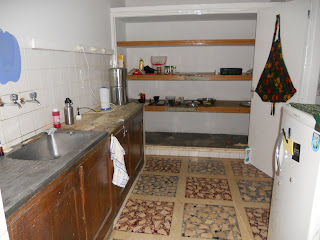
And here's the inside...


A Minha Escola

There are certain times where I simply have no idea how things came to be...but I'm grateful for them, anyway. At the Universidade Catolica de Mocambique, where I was originally brought to teach English, I am now also the Director of the Communications program (something about the director they had in mind deciding to quit the week before classes started...).
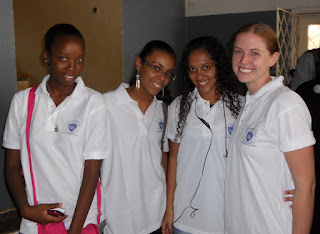

So, I've got a group of students starting the first year of the new communications program that I get to introduce to ideas of press freedom, writing skills, accuracy, brevity and timeliness, and all those other things that made me fall in love with journalism. Unfortunately, I don't get to beat them over the head with AP Style and the First Amendment, since those don't exist here. Here are a few of my students representing in the communication's department white and blue.

Again, I have no idea how I just happen to luck into these things...but I won't ask questions and just work and hope they keep happening.

Wednesday, 1 February 2012

Back in Moz!

I’m back in Moz for Year 3! I arrived just in time to kill a few days at the beach, catch up with old friends, help with a PC conference and am now settling into my new role in the Maputo office before I move to Chimoio next week.


One fun aspect that met me upon arrive was Cyclone Funso, sliding down the channel between Mozambique and Madagascar. Really, all this meant for me was that a little rain during the night, frequent paranoid text messages from the PC Safety & Security officer and a little trouble getting back down to Maputo, thanks to a missing bridge that was miraculously “rebuilt” in 48 hours (there is one highway in southern Mozambique, so the capital was essentially cut off from the rest of the country – it’s amazing what can be accomplished with the proper incentive).

So here's the lack of bridge...


And here's what we drove across three days later...


Once I eventually get to my new site, I’ll be working as a sort-of adjunct professor at the Universidade Catolica de Moçambique; but the majority of my time will be spent with Peace Corps, working through their office in Chimoio (staff of three, when you count me…). I’ll keep you posted here, so keep checking back for updates!

Thursday, 10 November 2011

Border Crossing

While boleia-ing home one afternoon, I had the great fortune of attracting the attention of a white SUV with a license plate from Gauteng Province – I had succeeded in what is typically thought impossible: the much-coveted South African boleia.
“Are you going to Chokwe?” I ask when they pulled over.
The middle-aged couple take a moment to consult their map before confirming that yes, they are headed to Chokwe.
“Great!” I say, and start to open the back door. I quickly realize it’s locked. And then I remember… oh right, South Africans. I lean back over to the passenger window and after running through a list of possible English translations for “boleia” settle for asking, “Um…could I get a ride?”
“Oh sure!” And the man unlocks the door and I climb in the backseat amid ice chests, bags of canned and processed food, fishing gear, suitcases and, miracle of miracle, air conditioning. I had found the four-leafed clover, the pot of gold at the end of a rainbow, the star power in the question box, and now my road would be easy.
Of course, the questions start.
So, you’re not afraid to hitchhike here? Not at all, it’s very common, and much safer than public transportation. Do you speak their language? Yes – I teach in Portuguese. What are you doing here? And the standard spiel about volunteering with Peace Corps, etc.
At this point, the wife turns around in her seat, and I can see the concern spilling out of her eyes as she ingenuously questions…
“Your students at the school, are some of them…black?”
(pause)
She’s speaking English, so I know there’s not a translation issue. But I suddenly feel like these people are so far from the world I know that I’d have more in common with a Portuguese-speaking Mozambican boleia.

Oh, South Africa.

This was one of my first real eye-opening experiences with the people who look like me living in the “developed” country next door, the one with the highest per capita on the continent and, startlingly, also one of the highest crime rates. I’ve only spent a brief time there myself – enough time to relish in efficient customer service and commercialism, but not enough time to have any idea about the culture. While answering questions and explaining a little about my life in Mozambique to the beach-bound tourists I often encounter, I also learn a lot about their country. Questions like these speak volumes.

At first, I thought most of the South Africans I encountered were simply the elite – they drive through Mozambique in their caravan of SUVs stuffed with food and water from their own country and their boats or trailers hitched on the back, not getting out of their cars from the border crossing to the resort run by their fellow South Africans except to fill up their 50-gallon tanks at the legit gas stations where the Indian owners accept credit cards and speak English better than they do. Naturally, these types are probably just as sheltered in their own country and completely unaware of how the other 95% of their fellow citizens live, and so I shouldn’t judge their country based on such a select group.

But then you run into the working class guys, usually here in Mozambique to make use of the country’s natural resources, so they can send the gas or water or sweet corn back to South Africa to be processed and packaged and sold back to Mozambique for triple the price, without Mozambique actually seeing a penny of profit.

One South African friend, who invited us to a barbeque (“braai” in South Africa) on the beach one day, comes from a family of farmers, far from the tourist hubs of Cape Town or skyscraper-lined Johannesburg. He told us about the atrocities black South Africans commit against his fellow farmers, burning the land and raping the white women, and how they had assassinated the president of the white-only Afrikaans farmers’ union. He told us about how these horror stories never made the newspapers because the media was corrupted by the government, run by a black president. He told us about how things were so much better during apartheid – less crime, less fear, more breaks for hard-working white folks. He told us about how he used to be friends with a volunteer up north, until they meet for a drink one day and she brought along her boyfriend – a black Mozambican – and he hadn’t spoken to her since then. He told us about how his niece goes to a preschool where a black kid also goes, and his brother forbids her to play with him and tells the teacher that he’ll take her out of the school if the black kid even touches his daughter. He told us how blacks are more like animals than whites, not even using a fork when they eat, but just using their hands. He told us how blacks just don’t deserve the rights they have in South Africa.

(At this point I think back to Mama Celeste, and remember the countless times she ate with her hands – there were three forks in the house, including a plastic one saved from a neighbor’s fancy wedding some years back, and when everyone was home those three weren’t enough to go around, so Mama C always made sure I had a fork and opted to wait until we were finished before cleaning one and using it herself or simply eating with her hands when possible.)

The one thought that kept running through my mind during this enlightening conversation was that South Africa today sounds exactly like what I would imagine from a pre-Civil Rights era United States. And it makes sense. Apartheid – the South African law of strict separation between whites and blacks – was eliminated less than twenty years ago. The majority of the blacks in South Africa have relatively new-found liberties after centuries of suppression, lack of decent education and generally being seen as less than human. And the whites are dealing with the fact that they are no longer entitled to all the perks of being superior and unquestionably in charge. Though the 13th, 14th and 15th Amendments to the U.S. Constitution made African Americans legally equal to whites in the late 1800s, it wasn’t until well after the Civil Rights movement that things really started to change there.

And the things he had to say about Nelson Mandela – did people once think the same thing about Martin Luther King Jr., who is today heralded as a hero of peaceful change in our culture? And do people honestly believe they have a God-given superiority over an entire race of people – to the point that they don’t even consider them to be the same race?

But being judgmental would just be hypocritical. I know without a doubt that had I been born in the US a century before, I would have the exact same view as these South Africans. These opinions are a reflection of society more than the individual. It's purely cultural.

Though I grew up in podunk Azle, with a larger number of trailer parks than African Americans, I also grew up watching The Bill Cosby Show with my grandparents, learning to count in Spanish on Sesame Street, celebrating Black History Month in schools, and singing “Red and yellow, black and white, they are precious in His sight…” at Sunday school. It has been ingrained in me since childhood that people of any race, belief, culture and country are created equal, and deserve respect accordingly. I’m not naïve enough to think that America is free of racism, discrimination and its fair share of race-based hate crimes, but I've never encountered someone my age who so adamantly held these beliefs, which I consider to be "old-fashioned."

Moreover, he was equally surprised that I, also being white, did not hold the same beliefs. We live in Mozambique as the average citizen does – we have the same cookie-cutter concrete houses as our colleagues, we speak (more or less) the same language they do, we also lament when water stops running or stretch out on our esteiras when it’s just too unbearably hot inside the house, and they are the people we turn to when we need help.

We told him these things. He seemed puzzled. Not really sure how to respond.

Of course, we also have South African friends living in Mozambique who are trying to learn the language, make friends and respect the cultural differences, frustrating as they might be at times. They make the effort, and they enjoy living in Moz because of it.

But when the South Africans from the aforementioned boleia stopped to drop me off at the market in Chokwe, they at first refused on the grounds that it wasn’t safe. I could understand their concern – the market is a mass of mud-and-stick stalls next to a chapa stop, where your car is swarmed by people wanting to sell you pirated phones, cheap plastic jewelry and homemade egg sandwiches out of a bucket when you stop. I have to assure them that it’s okay – I’m here every day, they know me, and I’m perfectly safe.

“You would never leave a white girl at a place like this in South Africa. There’s no telling what they’d do to you,” the man says as he reluctantly unlocks my door.

Unlike Mozambique, South Africa has an airport with more than one baggage claim, they have more than one TV channel, they have multiple-lane highways with brdiges and wastewater treatment plants, they have oatmeal, sanitary packaged meat, grapes and peaches, as well as big, clean cities where they hold world sporting events like the World Cup. But I feel perfectly safe in my town here in Mozambique. I’ll take that over McDonald’s any day.

My friend says he’s sure that all the racial tension and violence will lead to a full-on war between South African whites and blacks. I say I’m certain things will get better – it just might take a few generations.